Gritting Myth Busting
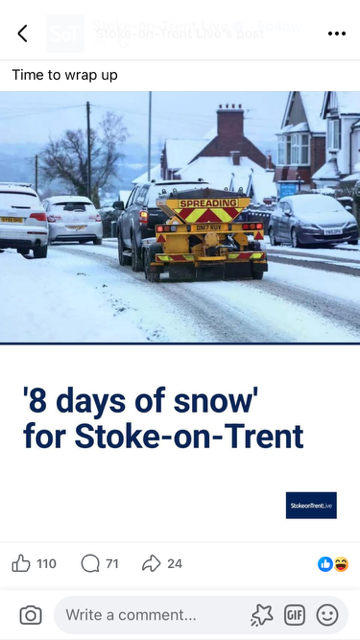
With forecasts indicating a significant drop in temperatures and the likelihood of snowfall over the coming days and into January 2026, following a relatively mild December, it is timely to review both the capabilities and the limitations of gritting operations.
Private gritting clients typically have budget provision for only one gritting application per night. During periods of severe weather, particularly snowfall, this limited approach can come under pressure and may lead to dissatisfaction or negative feedback from clients. This should be contrasted with local authority winter service operations, where up to four gritting runs may be carried out within a 24-hour period. When combined with continuous traffic movement, this level of treatment is generally effective in keeping snow from accumulating on roads under typical UK winter conditions.
By comparison, private clients, such as factory or distribution centre owners, are often unable or unwilling to fund multiple gritting operations within the same period. As a result, during more severe weather events, outcomes may not meet expectations, despite reasonable operational efforts.
Although heavy salt application, assisted by vehicle tyre movement, can remove snowfall of up to approximately 40mm, it is important that customers maintain realistic expectations regarding the condition of their sites following overnight snowfall, particularly when inspections are carried out early the following morning.
Gritting: Myth Busting
Gritting is an important part of keeping our customers' sites safe during winter, but it is often misunderstood. Below are some common myths about gritting and the facts behind them.
Myth 1: Salt melts ice instantly
Fact: Gritting is only the start of the de-icing process. Salt works by lowering the freezing point of water to form a brine. This takes time to penetrate ice and is not immediate, particularly in very cold conditions.
Myth 2: Roads are safe to drive as normal once gritted
Fact: Gritting improves grip but does not return roads to summer conditions. Braking distances remain significantly longer, and factors such as air temperature, wind, rain, and traffic levels can reduce the effectiveness of treatment.
Myth 3: Gritting clears snow from roads
Fact: Salt and grit do not remove snow. They help prevent snow from bonding to the road surface and turning into ice. Snowploughing is required to physically remove heavy or prolonged snowfall.
Myth 4: If a road has been gritted, snow won’t settle
Fact: Snow can still settle on treated roads. Heavy snowfall can bury or dilute salt before it works, and vehicle traffic can compact snow, making it harder for salt to penetrate.
Myth 5: More salt means better results
Fact: Using more salt than recommended does not improve safety. Correct spread rates are essential to avoid waste, environmental damage, and corrosion to vehicles and road surfaces.
Myth 6: Gritting works in all temperatures
Fact: Standard rock salt becomes much less effective below around -7°C. In very cold conditions, alternative treatments or mixed solutions may be required.
Myth 7: If roads look dry, they’re safe
Fact: Surfaces can still be affected by invisible black ice, especially overnight, early in the morning, or in shaded areas—even when surfaces appear dry.
Myth 8: Gritting prevents ice from forming completely
Fact: Gritting reduces the risk of ice but does not eliminate it. Salt can be washed away by rain, blown off by wind, or diluted by melting snow, allowing icy conditions to develop.
Wrap up and stay safe!


Comments